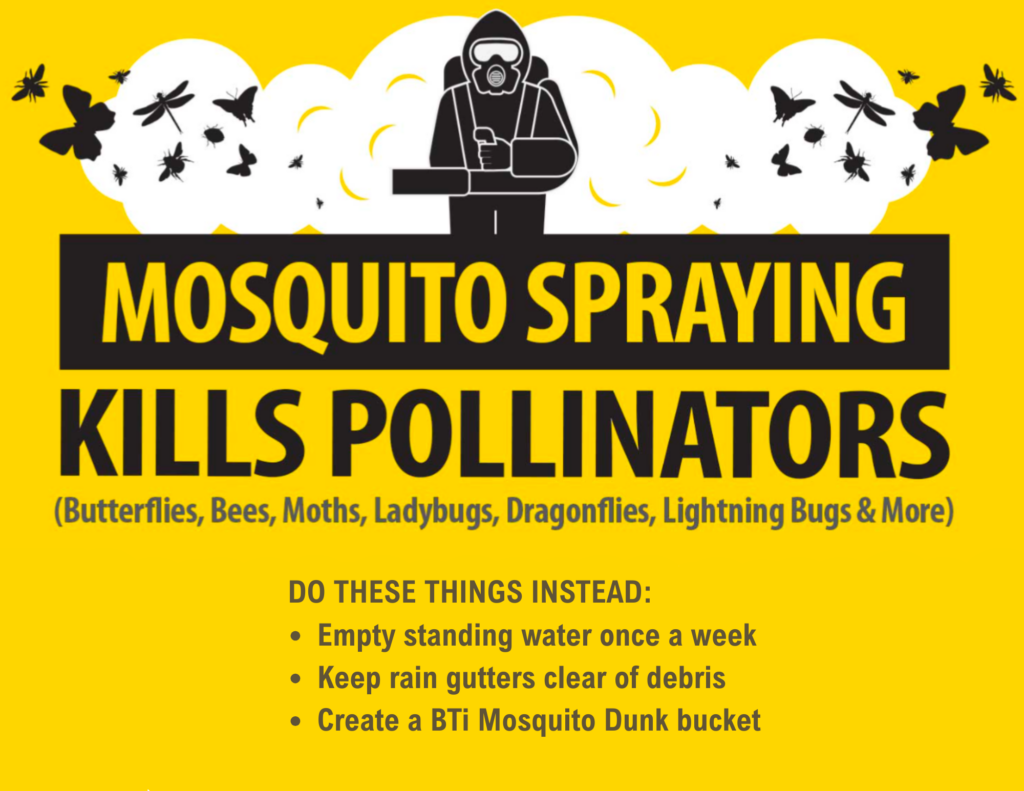
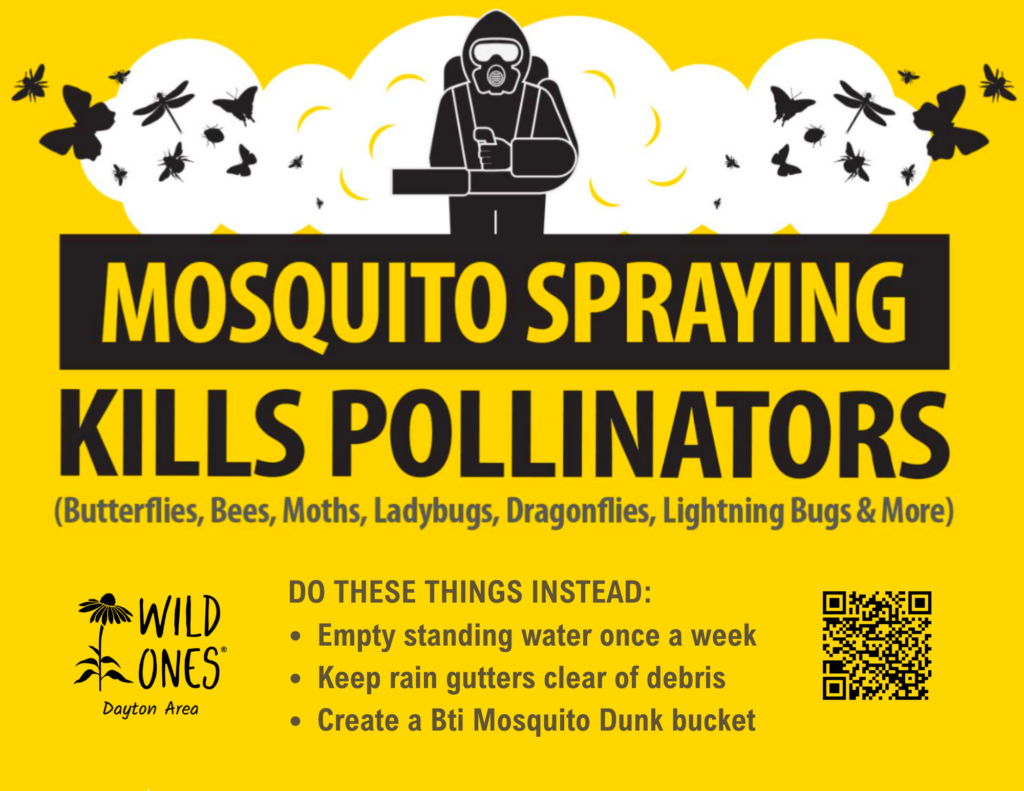
Did you know that mosquito spraying or “fogging,” including spraying done by local governments and by private companies that claims to be “eco-friendly,” can kill other insects and wildlife? It can also be harmful to pets and children.
Mosquito fogging is also ineffective at eliminating mosquito larvae, so any adult mosquitos killed are quickly replaced.
Here are some healthier steps to reducing mosquitoes in yards and neighborhoods:
- PLANT NATIVE: Creating a healthy ecosystem by planting species native to your area encourages ecological balance. You will attract birds, damselflies, dragonflies, toads and frogs, bats, and other native creatures that eat mosquitoes.
- DUMP STANDING WATER: Regularly dumping out smaller sources of standing water, where mosquito larvae may be growing, is one of the easiest mosquito control methods. Examples include pet water dishes, plant saucers, buckets, and bird baths.
- KEEP GUTTERS CLEAR OF DEBRIS: Debris in gutters contributes to standing water in gutters, where mosquito larvae can grow.
- CREATE A MOSQUITO BUCKET: See instructions at Homegrown National Park. Creating a mosquito bucket with a Bti tablet (or portion of a tablet) placed in stagnant water, as directed in the HNP Mosquito Bucket Challenge, will kill mosquito larvae but will not harm other pollinators and wildlife. Bti tablets contain Bacillus thuringiensis israelensis, a naturally occurring soil bacterium that targets and kills specific insect larvae before they can grow into biting adults.
Reduce Mosquito Fogging in Your Neighborhood with Homegrown National Park’s Mosquito Bucket Challenge
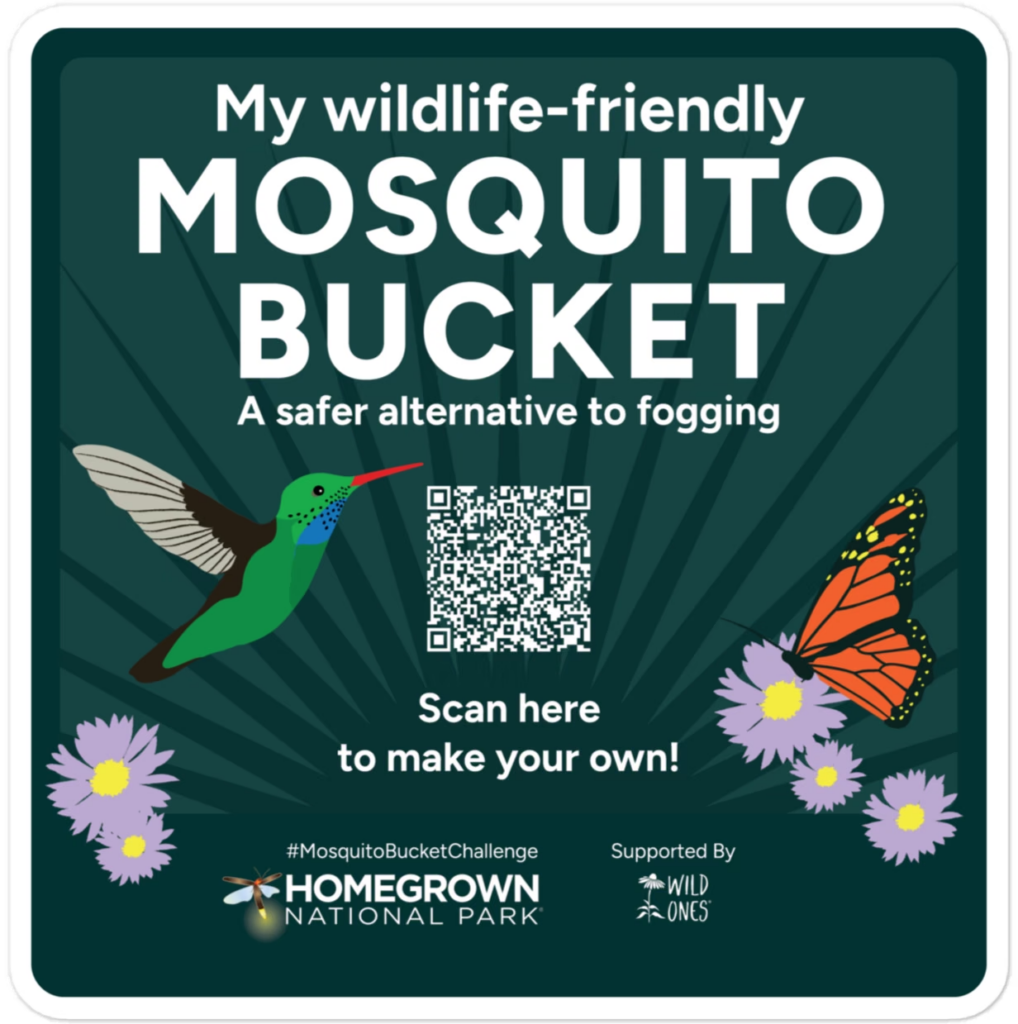
See the above links for the Wild Ones page about creating a mosquito bucket. Optional: decorate your bucket with paints or this vinyl sticker, which you can print yourself or order at the link.
Order Your “Stop Mosquito Spraying” Sign
Educate your neighbors and passersby; put up one of our “Stop Mosquito Spraying” signs in your yard or at your business.
We have available for sale 24×18 and 18×12 corrugated plastic signs for a suggested $15 and $10 donation, respectively, including a metal H stake. (The donation will cover our costs for the signs.) Contact us at [email protected] if you would like a sign, or look for us at native plant-related tabling events in the area. Local native plant vendor The Milkweed Patch will also sell signs for us at upcoming native plant sales in our area.
Resources:
- https://www.cdc.gov/mosquitoes/pdfs/bti-508.pdf
- https://www.epa.gov/mosquitocontrol/bti-mosquito-control
- https://doh.wa.gov/community-and-environment/pests/mosquitoes/bti
- https://pubmed.ncbi.nlm.nih.gov/16295540/
- Derua YA, Kahindi SC, Mosha FW, Kweka EJ, Atieli HE, Wang X, Zhou G, Lee MC, Githeko AK, Yan G. Microbial larvicides for mosquito control: Impact of long lasting formulations of Bacillus thuringiensis var. israelensis and Bacillus sphaericus on non-target organisms in western Kenya highlands. Ecol Evol. 2018 Jul 6;8(15):7563-7573. doi: 10.1002/ece3.4250.
- National Pesticide Information Center, 2000. Bacillus thuringiensis technical fact sheet.
- Bahrami R, Quaranta S, Perdomo HD, Bonizzoni M, Khorramnejad A. Carry-over effects of Bacillus thuringiensis on tolerant Aedes albopictus mosquitoes. Parasite Vectors. 2024 Nov 7;17(1):456. doi: 10.1186/s13071-024-06556-3.